1. Context
A Fraud Analyst reviews transactions that may be fraudulent, looking at the details and history to determine what’s really happening. They piece together transaction data, account activity, and customer history to decide whether a transaction is legitimate or needs further investigation.
I designed a fraud detection platform that brings the investigation process into one connected experience. Analysts can monitor multiple transaction types, investigate suspicious activity in detailed review drawers, create custom detection rules, follow ongoing investigations, and review past decisions, all in one place.

Abrigo Fraud Detection

2. The Problem
Small teams at community banks were losing millions of dollars to Fraud annually.
Fraudsters were evolving quickly, while the tools institutions rely on to identify and shut down suspicious activity weren't keeping pace.
-
Fraud was getting harder to catch. Fraudsters were constantly changing their tactics, making static approaches to detection less effective.
-
Analysts were buried in manual work. Reviews meant piecing together transaction details, check images, account history, and other information across disconnected tools and processes.
-
Institutions needed more control. Every institution has a different tolerance for risk, but their tools didn’t always give them the flexibility to adjust how suspicious activity was identified and prioritized.
-
Investigations lacked continuity. Analysts needed a better way to follow a transaction from the initial alert through investigation, customer outreach, decision, and historical review.
3. My Role
Lead & Sole UX Designer
After several years of untangling and redesigning some of Abrigo’s largest, most complex products, I was brought on as the sole designer for its new Fraud Detection Suite.
Working closely with Product, I designed the experience from the ground up, starting with check fraud as the initial MVP while building the foundation to support additional transaction types. This included dashboards, review workflows, permissions, analytics, settings, integrations, and customizable detection rules.
The result was a connected suite of tools that supported the full fraud detection process and could grow as new transaction types were introduced.
4. Feedback
User feedback is at the heart of how I design. The best solutions come from what users need, not what we assume they need. Abrigo serves more than 2,400 financial institutions, so we worked with a smaller group representing a broad range of our core users through interviews, usability testing, and beta programs, along with ongoing input from our internal Customer Advisory team.
24
Community
Banks
32
Fraud
Analysts
12
Fraud
Officers
17
Abrigo
SMEs
5. Key Decisions

Build a Detection Engine Institutions Could Trust and Tailor
For check fraud, we partnered with Mitek and combined image analysis, behavioral transaction analysis, and customizable flagged rules to look for different signs of fraud. Institutions could set thresholds around their own risk appetite, including when transactions could be automatically approved or declined and when they needed human review.
No single signal could tell the whole story. A check might look suspicious because of something in the image, unusual transaction behavior, or several smaller risk factors working together. And because every institution approached risk differently, they needed control over which combinations were concerning enough to require an analyst.

Design for checks first, without designing only for checks
I designed a central Fraud Detection dashboard and transaction queue where analysts could monitor suspicious activity across multiple transaction types and quickly see what required their attention. The structure was built to expand beyond checks to ACH, wires, and others, while supporting the different review processes each would require.
Starting with a shared dashboard and queue meant we could add new fraud products without rebuilding the core experience each time. New transaction types could plug into the same foundation as the suite grew.

Bring the Investigation to the Analyst
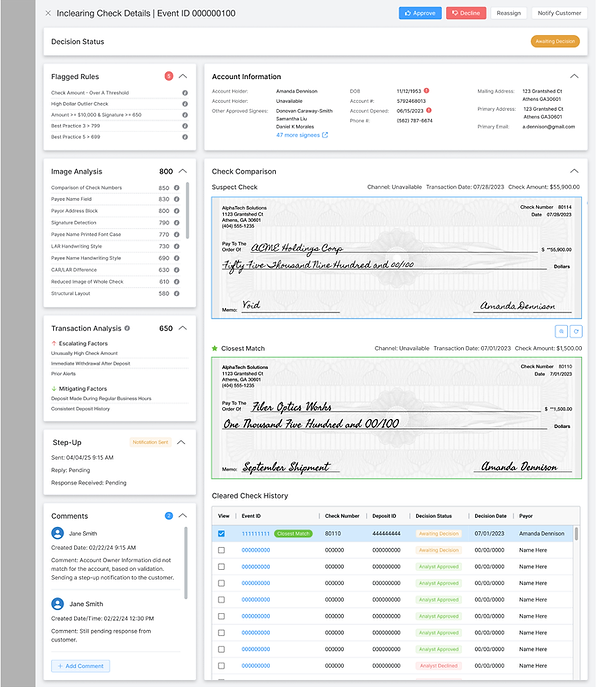
Transactions opened directly from the queue into a focused review workspace where analysts could see what was flagged and why, including image analysis, transaction analysis, flagged rules, account activity, and customer history.
For checks, Mitek also surfaced the closest matching check from the customer’s cleared history next to the suspect check. Analysts could compare them side by side or choose any previous check themselves, cutting down on the searching while leaving the actual investigation and decision in their hands.

Carry the Context Into the Next Investigation
Analysts could approve or decline transactions through clear decision workflows, with every outcome captured in Decision History. Every declined transaction warrants further investigation and continues into Abrigo’s existing BSA investigation process. BSA Analysts investigate suspicious activity to determine whether it requires further action or regulatory reporting.
A suspicious transaction could be part of a larger pattern involving the customer, their accounts, relationships, or other activity. Connecting the two meant analysts could keep investigating without losing the work and context that started in Fraud Detection.
6. Impact
$47M in Check Fraud Detected
In 2025 alone, Abrigo Fraud Detection detected $47 million in check fraud across its customers.
$1M+ Prevented by One Institution in First 30 Days
Within the first 30 days of the initial launch, one institution prevented more than $1 million in fraud losses.
90%+ of Fraudulent Check Value Identified
Fraud Detection identified more than 90% of fraudulent check value for its most engaged early adopters.
75% Reduction in Fraud Review Time
One institution reduced fraud review time by 75% with Abrigo Fraud Detection, helping analysts investigate suspicious activity and reach decisions significantly faster.
ROI in Under 6 Months
Customers have been able to recoup their investment in six months or less through reductions in fraud losses.
Scaled to ACH + Wire in 6 Months
Within six months of the initial launch, we expanded the platform to support ACH and wire fraud, while preserving the core experience analysts already knew.
Opened a New Product Vertical
Fraud Detection opened a new area of financial crime investigation for Abrigo, creating significant new sales opportunities while extending the value of its existing BSA/AML products.

7. Design Examples
Below is a curated selection of screens.
Please keep in mind the full scope of work was much larger.